


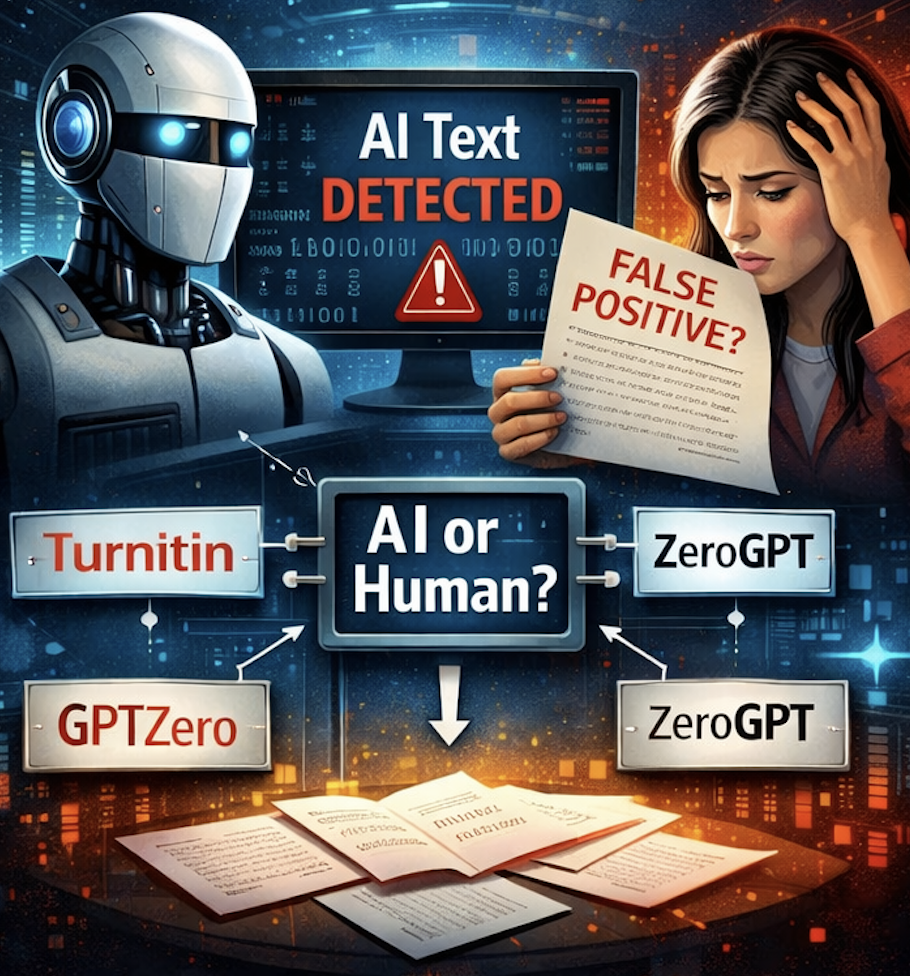
AI detectors like Turnitin and GPTZero claim to identify AI-generated text. Here’s how they work, why they fail, and when they should not be trusted.
Introduction
In 2025, AI content detectors have become standard tools across universities, newsrooms, hiring platforms, and digital publishers. Their promise is simple: determine whether a text was written by a human or generated by artificial intelligence.
The short answer is uncomfortable but necessary: no AI detector is fully reliable.
Despite this, tools such as Turnitin, GPTZero, and ZeroGPT are already being used to make academic, professional, and even legal decisions. This article explains how AI detectors actually work, what they measure, why false positives are common, and why their misuse has become a serious ethical issue.
What is an AI detector and what is it used for?
An AI detector is a system that analyzes linguistic and statistical patterns in a text to estimate whether it resembles output generated by large language models.
They are commonly used in:
-
Education (academic integrity and plagiarism prevention)
-
Media and SEO quality control
-
Human resources and recruitment
-
Content moderation platforms
⚠️ Key point: AI detectors do not detect authorship. They only calculate probabilities based on patterns.
How do AI detectors work?
Short answer
They analyze perplexity, entropy, and predictability in language.
Clear explanation
AI-generated text often shows:
-
Highly regular grammar
-
Statistically predictable word choices
-
Consistent structure with little randomness
Detectors compare the text against large datasets of known AI-generated and human-written content, then return a likelihood score, not a verdict.
What they do NOT do
-
They do not know who wrote the text
-
They do not track user behavior
-
They do not understand intent or context
The most common AI detectors in 2025
Turnitin AI Detector
Widely used in universities worldwide. Integrated into plagiarism systems, but heavily criticized for false positives, especially in well-written academic papers.
GPTZero
Popular among educators. Uses perplexity and “burstiness” analysis. Works better with long texts, but struggles with edited or hybrid content.
ZeroGPT
Common in SEO and publishing environments. Less academically rigorous, but widely adopted by content creators.
👉 All of them share the same structural limitation: AI and humans are increasingly writing in similar ways.
When do AI detectors fail?
1. False positives
Human-written texts are often flagged as AI when they are:
-
Technically precise
-
Clearly structured
-
Professionally edited
2. Hybrid content
Texts written by humans with AI assistance confuse detection systems.
3. Non-English languages
Detection accuracy drops significantly in Spanish, Portuguese, and other non-English languages.
4. New AI models
Detectors always lag behind the latest generation of AI systems.
Is it ethical to punish people using AI detectors?
This is where the real controversy begins.
Official position
Most providers state their tools should be used as supporting signals, not final proof.
Real-world practice
-
Students are failed
-
Job applicants are rejected
-
Creators are penalized
📌 No AI detector should be used as sole evidence. Even the companies behind them acknowledge this—usually in fine print.
Can AI detectors be bypassed?
Yes. And that’s part of the problem.
-
Human editing
-
Manual paraphrasing
-
“Text humanizer” tools
-
Stylistic rewrites
This shows that AI detection is not a structural solution, but a temporary workaround.
Frequently Asked Questions (FAQ)
Does Turnitin reliably detect ChatGPT?
No. It provides probability estimates, not certainty.
Can human text be flagged as AI?
Yes. This is one of the most common failures.
Do AI detectors work well in English only?
They perform best in English and worse in other languages.
Do AI detectors matter for SEO?
No. Search engines evaluate quality, not whether content is AI-generated.
Conclusion
AI detectors are not truth machines. They are statistical estimators operating in an environment where the difference between human and machine writing is rapidly shrinking.
In 2025, the problem is no longer who wrote the text, but whether the content is accurate, useful, transparent, and responsible.
Relying blindly on AI detection tools risks errors, unfair treatment, and flawed decisions.
References (APA)
-
Turnitin. (2024). AI writing detection overview. https://www.turnitin.com
-
GPTZero. (2024). How AI detection works. https://gptzero.me
-
OpenAI. (2024). Why AI detection is unreliable. https://openai.com